

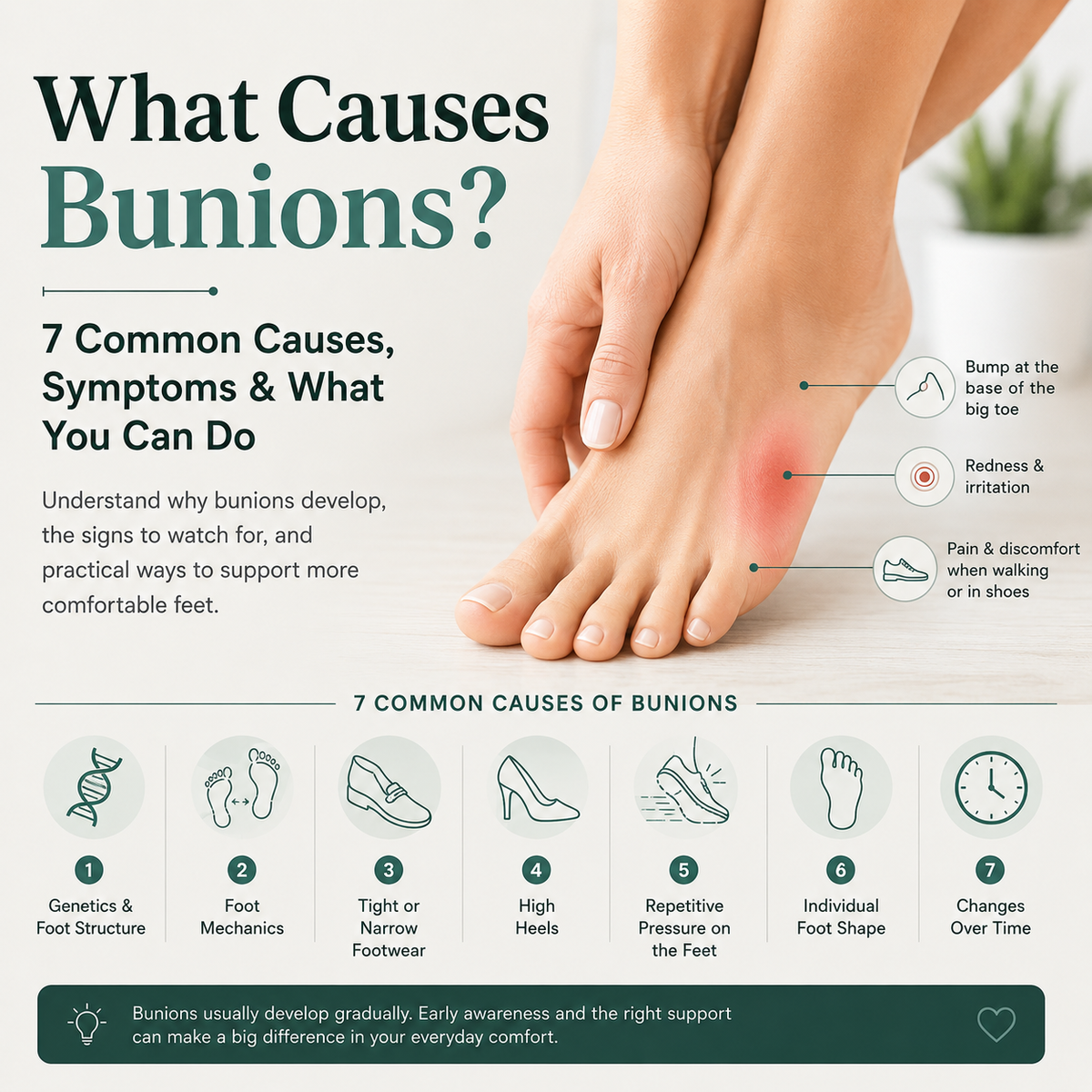
If you’ve noticed a bump forming at the base of your big toe, or your big toe seems to be leaning toward the others, you may be dealing with a bunion.
Bunions are common, but they can be frustrating. For some people, they’re mostly a cosmetic concern. For others, the pressure around the big-toe joint can make certain shoes uncomfortable and turn everyday activities like walking or standing into something they’re constantly thinking about.
So, what actually causes bunions? And if you already have one, what can you do to make your feet more comfortable?
Here’s what you should know.
What Is a Bunion?
A bunion, medically known as hallux valgus, is a change in the alignment of the big-toe joint.
As the big toe gradually shifts toward the smaller toes, the joint at its base can become more prominent, creating the characteristic bump along the inside of the foot.
A bunion usually develops gradually rather than appearing overnight.
Depending on the person, it may be accompanied by:
- A visible bump at the base of the big toe
- The big toe leaning toward the second toe
- Redness or irritation around the joint
- Tenderness or discomfort
- Pressure or rubbing inside shoes
- Reduced movement of the big toe
- Corns or calluses where toes rub together
Not everyone experiences the same symptoms. Some people have a noticeable bunion with relatively little discomfort, while others find that even a smaller bunion makes certain shoes or activities uncomfortable.
What Causes Bunions?
There usually isn’t one single explanation.
The structure of your feet, how they move, your footwear, and other factors can all influence how pressure is distributed around the big-toe joint.
Here are seven factors commonly associated with bunions.
1. Genetics and Foot Structure
Your natural foot structure can play an important role.
You don’t necessarily inherit a bunion itself, but you can inherit characteristics of the foot that may make bunion development more likely.
For example, certain foot shapes or mechanical patterns may place more stress around the big-toe joint over time.
This also helps explain why bunions sometimes appear in several members of the same family.
2. The Way Your Foot Moves
Every step involves a complex interaction between your toes, arches, ankles, and the rest of your lower body.
If the mechanics of your foot consistently place additional stress around the big-toe joint, that repeated pressure may contribute to changes in alignment over time.
This is one reason bunions aren't simply a problem with the appearance of the big toe—the mechanics of the entire foot matter.
3. Tight or Narrow Shoes
Shoes with a narrow toe box can squeeze the toes together and put additional pressure on the big-toe joint.
Footwear isn't necessarily the sole cause of a bunion, but shoes that compress the toes can aggravate an existing bunion and make symptoms more noticeable.
If you already have a bunion, pay particular attention to the toe box of your shoes.
Your toes should have enough room to sit naturally without being forced together.
4. High Heels
High heels can shift more of your body weight toward the front of the foot.
Many high-heeled shoes also have narrow or pointed toe boxes.
Together, these characteristics can increase pressure around the forefoot and toes.
You don't necessarily need to eliminate every pair of heels from your wardrobe, but if your bunion becomes uncomfortable while wearing them, alternating with roomier, lower-heeled footwear may help reduce pressure.
5. Repeated Pressure on the Feet
Your feet handle thousands of steps during an ordinary day.
For people who spend long periods standing, walking, exercising, or working on their feet, repeated pressure can make an already sensitive area more noticeable.
This doesn't mean activity itself causes bunions.
Instead, the important question is how pressure is being distributed across your feet and whether your footwear gives your toes enough space and support.
6. Your Individual Foot Shape
No two pairs of feet are exactly alike.
Differences in toe length, joint structure, arch shape, and overall foot anatomy can influence how forces travel through your feet when you stand and walk.
For some people, that anatomy may make the big-toe joint more susceptible to developing the characteristic alignment associated with a bunion.
7. Changes Over Time
Bunions often develop progressively.
Years of repeated movement and pressure can make changes in the big-toe joint increasingly noticeable.
That's why someone may first notice only a small bump and later realize their big toe has shifted further toward the neighboring toes.
Age alone doesn't mean you'll develop bunions, but the effects of foot mechanics and repeated pressure can accumulate over time.
What Are the Early Signs of a Bunion?
Catching changes early can make it easier to adjust your footwear and habits before discomfort starts interfering with everyday activities.
Watch for signs such as:
A small bump beside the big toe
This is often one of the first visible changes.
Your big toe beginning to lean inward
Compare both feet. You may notice that one big toe points toward the second toe more than the other.
Shoes suddenly feeling tighter around the forefoot
A pair of shoes that used to feel comfortable may begin rubbing against the side of the big-toe joint.
Redness after wearing certain shoes
Repeated friction against the prominent joint can irritate the area.
Discomfort after long periods of walking or standing
Some people notice little discomfort at rest but become more aware of the area after spending hours on their feet.
Can bunions progress?
Bunions may become more pronounced over time, but the rate and symptoms vary. Read how bunion progression can affect alignment and function.
What Can You Do About a Bunion?
If your bunion is bothering you, there are several conservative steps that may make everyday life more comfortable.
Choose Shoes With More Toe Room
Start with your footwear.
Look for shoes with a wide, comfortable toe box that allows your toes to sit naturally.
A wider toe box can reduce rubbing and pressure against the bunion, especially if your current shoes feel tight around the front of your foot.
Avoid Shoes That Aggravate It
Pay attention to patterns.
If a particular pair consistently leaves the bunion red, irritated, or uncomfortable, that's useful information.
You don't necessarily need an entirely new wardrobe. Simply reducing the amount of time spent in shoes that compress the toes can make a noticeable difference in everyday comfort.
Reduce Friction and Pressure
Depending on your needs, padding or other forms of foot support may help reduce direct rubbing against footwear.
The goal isn't to force the foot into an unnatural position.
It's to make everyday movement more comfortable and reduce unnecessary irritation.
Give Your Feet a Break
If you've spent all day standing or walking, allowing your feet time to recover can help with temporary discomfort.
Changing into roomy footwear when you get home can also remove some of the pressure that has accumulated throughout the day.
Maintain Comfortable Movement
Gentle movement can help maintain mobility, but don't force your big toe through painful ranges of motion.
If a movement consistently causes pain, stop rather than trying to push through it.
Can a Bunion Corrector Help?
This is where expectations matter.
A bunion corrector or bunion splint is designed to provide support around the big toe and help maintain a more comfortable position while the device is being worn.
Depending on its design, a corrector may also help reduce rubbing or pressure and provide adjustable support around the big-toe area.
However, a bunion corrector should not be viewed as a device that permanently straightens the bone or cures a bunion.
Think of it as a support tool, not a permanent correction.
For example, an adjustable design such as the Altaeron Adjustable Bunion Corrector allows the amount of support to be adjusted rather than relying only on a fixed toe spacer.
If you're considering one, look for features such as:
- Adjustable support
- Comfortable contact surfaces
- Secure fit
- Easy-to-control adjustment
- Compatibility with the foot you intend to use it on
- Clear instructions for gradual use
Start conservatively. More pressure isn't automatically better.
How do conservative devices differ?
Correctors and spacers serve different purposes. See the dedicated corrector and toe-spacer comparison.
When Should You See a Healthcare Professional?
Home comfort strategies aren't appropriate for every situation.
Consider speaking with a qualified healthcare professional if:
- Your pain is persistent or getting worse
- Walking is becoming difficult
- The joint becomes significantly swollen or inflamed
- Your big toe movement becomes substantially limited
- You develop numbness or unusual sensations
- You're unsure what's causing your symptoms
- The bunion is interfering significantly with daily activities
A clinician can examine your foot and determine whether your symptoms are actually related to a bunion or another condition.
If conservative measures aren't enough, they can also discuss other treatment options with you.
Frequently Asked Questions
Are bunions caused by wearing the wrong shoes?
Not necessarily.
Foot structure and mechanics can contribute to bunion development. However, tight, narrow, or pointed shoes can put additional pressure on the toes and may aggravate an existing bunion.
Can you permanently straighten a bunion without surgery?
Products such as splints, correctors, and toe spacers shouldn't be expected to permanently realign the underlying bones.
They are better thought of as tools for support, positioning while worn, or comfort.
Can I wear a bunion corrector every day?
That depends on the device and your individual tolerance.
Follow the manufacturer's instructions and begin gradually rather than immediately wearing a new device for extended periods.
Stop using it if it causes significant pain, numbness, or irritation.
Can you get bunions on both feet?
Yes. Bunions can occur on one or both feet, and the severity doesn't necessarily have to be the same on each side.
Are bunions only a problem for older adults?
No.
Although bunions may become more noticeable over time, younger adults can develop them as well, particularly when foot structure and mechanics predispose them to changes around the big-toe joint.
The Bottom Line
Bunions aren't simply caused by one bad pair of shoes.
They develop through a combination of factors that can include foot structure, genetics, mechanics, footwear, repeated pressure, and changes that occur over time.
If you already have a bunion, the practical goal is to make choices that reduce unnecessary pressure and keep your feet as comfortable as possible.
That may mean choosing roomier shoes, paying attention to activities that aggravate the area, and considering supportive products when appropriate.
Most importantly, keep expectations realistic.
A supportive device can help with support and comfort while worn, but it isn't the same thing as permanently correcting the underlying bunion.
If pain persists, worsens, or begins limiting your everyday activities, getting an individual assessment from a qualified healthcare professional is the appropriate next step.


