

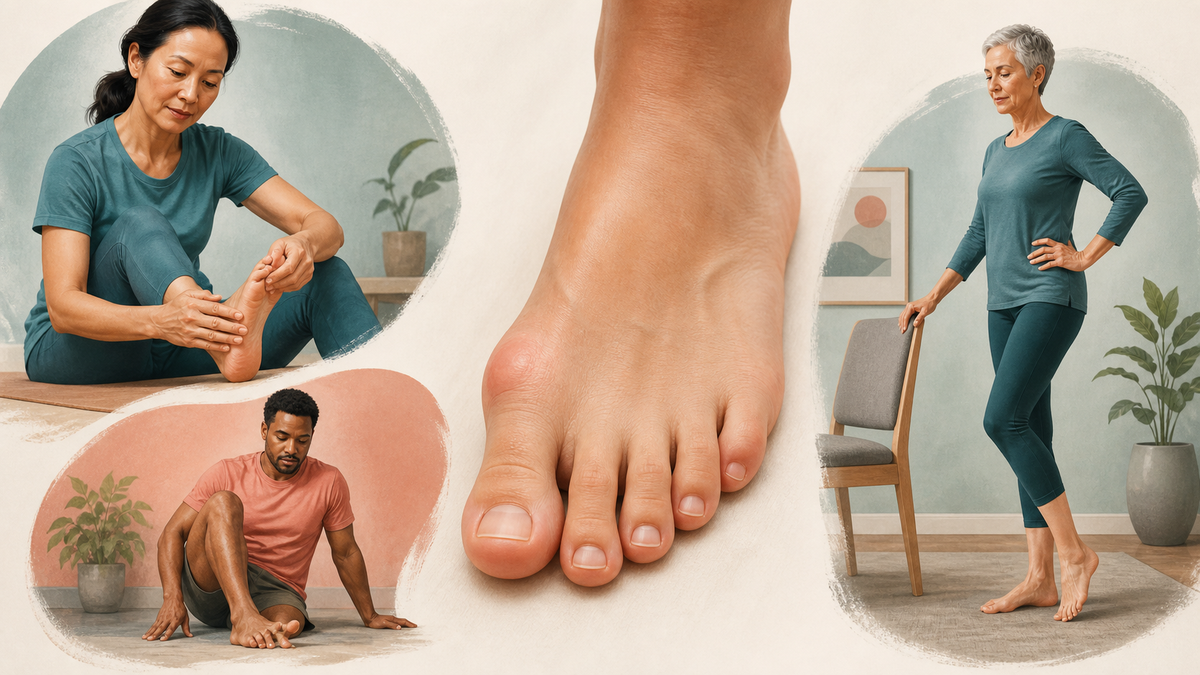
Bunion exercises may help selected people improve foot strength, movement or pain, especially as part of a broader conservative program. Recent reviews report encouraging findings for mild-to-moderate hallux valgus, but studies are small and exercise programs vary. Exercises should not be promised to permanently reverse the deformity or replace assessment when pain is significant.
What are exercises trying to change?
Programs may target big-toe mobility, intrinsic foot-muscle strength, balance and control during standing or walking. The goal should be functional comfort, not forcing the toe straight.
What does the research show?
A 2022 systematic review found low certainty across nonsurgical interventions, with pain improvement more consistent than angular correction. A 2026 network meta-analysis found exercise—particularly combined with taping or orthoses—promising, while calling for larger high-quality trials.
What is a safe starting principle?
Use slow, comfortable movement and stop if an exercise increases joint pain, swelling or numbness. A physical therapist or podiatrist can tailor exercises when stiffness, arthritis or another diagnosis changes what is appropriate.
Can exercises replace shoes or treatment?
No single exercise offsets constant pressure from poorly fitting footwear. Exercise may be one part of management alongside shoe fit, activity planning and other symptom measures.
Compare the full treatment landscape.
Who should get advice first?
Seek guidance before starting if symptoms followed an injury, the joint is hot and acutely swollen, walking is difficult, or you have diabetes, reduced sensation or a neurological condition.
What exercise programs have studied
Research has not tested one universal “bunion exercise.” Programs have included active big-toe abduction or toe-spreading control, short-foot or arch-control work, intrinsic foot-muscle strengthening, joint-mobility techniques, balance tasks and gait-related training. Some studies combined exercise with taping, orthoses, splints or other physical-therapy components, making it difficult to isolate the effect of exercise alone.
What the 2022 systematic review found
The 2022 systematic review and meta-analysis included 18 studies across many nonsurgical interventions. Most samples were small and risk-of-bias concerns were common. Five pooled analyses for orthoses, splints, manual therapy and taping added to exercise did not show significant effects on the primary outcomes. Individual studies did report pain reduction for several interventions and clinically important angular changes in four studies, but the authors rated certainty low.
Their practical conclusion was cautious: pain improvement appeared more likely than improvement in the hallux valgus angle.
What the newer exercise review adds
A 2026 network meta-analysis included 11 randomized trials with 401 participants and focused on exercise alone or combined with external support in mild-to-moderate hallux valgus. Exercise outperformed an adjusted placebo for hallux valgus angle in the pooled model; exercise combined with taping or orthoses ranked highly for angle and pain outcomes. The authors still called for larger, higher-quality trials and better adverse-event reporting.
Network rankings should not be read as a prescription for every person. They compare varied programs indirectly as well as directly, and the included trials do not establish a permanent cure.
Pain, function and angle are different outcomes
- Pain: may improve even when alignment changes little.
- Function: includes strength, balance, movement and activity tolerance; it is not always measured consistently.
- Hallux valgus angle: a radiographic alignment measure; a statistically detectable change is not automatically a permanent or personally meaningful correction.
Practical categories—not a treatment prescription
A clinician-guided program might address comfortable big-toe motion, the ability to move the big toe away from the second toe without curling, intrinsic muscle control or balance. The appropriate starting point depends on joint mobility, pain, arthritis and other conditions. Forcing a stiff or acutely inflamed joint is not a sensible test of commitment.
How to set realistic expectations
Judge a program by a defined functional goal over a reasonable period: less discomfort during a usual walk, better tolerance of an appropriate shoe or improved control during a prescribed task. Stop and seek advice for increasing joint pain, swelling, numbness or a new gait problem. Exercises can be part of conservative care; they are not a “seven moves to straighten your toe” promise.
Important limitations behind the headlines
- Small trials: many studies include too few participants to estimate effects precisely.
- Different programs: “exercise” can mean very different combinations, intensity and supervision.
- Combined treatment: when taping or orthoses are added, the effect of exercise alone is uncertain.
- Short follow-up: a change after several weeks does not prove permanent structural correction.
- Outcome variation: pain scales, radiographic angles and functional measures answer different questions.
What a well-designed personal trial looks like
First confirm that exercise is appropriate for the diagnosis. Choose one or two clinician-supported tasks tied to a functional goal, record a simple baseline and avoid changing shoes, devices and exercises simultaneously. Reassess both benefit and irritation. This approach does not turn self-care into research; it simply makes the result easier to interpret.
Questions to ask a physical therapist or podiatrist
- Is my joint mobile enough for this movement?
- Which muscle or function is the exercise intended to address?
- What discomfort is acceptable, and what means stop?
- Should the program be combined with footwear, taping or an orthosis?
- How will we judge whether it is helping?
Key takeaways
Exercise is a potentially useful tool, not a cure. Judge it by comfort and function, progress gradually and keep expectations aligned with the still-developing evidence.


