

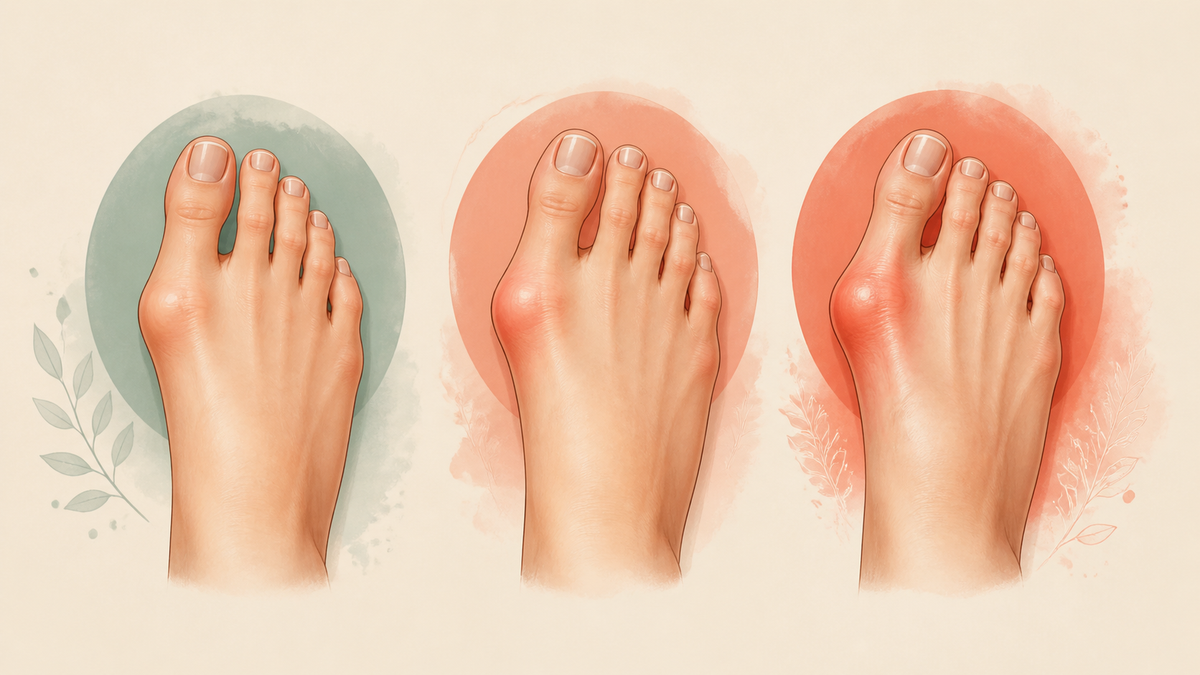
Mild, moderate and severe are useful descriptions of hallux valgus, but they are not reliable self-diagnoses. Clinicians consider the toe’s position, joint motion, neighboring-toe changes, symptoms and often measurements on weight-bearing X-rays. A visually prominent bunion can be relatively painless, while a smaller one can cause significant shoe pressure.
What may be noticed in a mild bunion?
The big toe may begin leaning toward the second toe, with a small prominence and intermittent irritation in narrow shoes. Motion can remain good, and everyday activity may be unaffected.
What may change as severity increases?
Toe drift and forefoot width may become more obvious. The second toe can become crowded or displaced, calluses may develop and the first MTP joint may become stiffer. These are general patterns, not a home grading system.
How do clinicians assess severity?
An examination considers alignment while standing, joint motion, tenderness, skin and gait. Weight-bearing X-rays can measure angles and show arthritis or other bone changes. Imaging is especially relevant when surgery is being considered.
Read how bunions are diagnosed.
Does severe-looking mean surgery?
No. Surgery is usually considered for meaningful pain or functional limitation that persists despite appropriate nonsurgical care, not appearance alone. Conversely, ongoing symptoms deserve assessment even if the deformity looks modest.
Compare options in the bunion treatment overview.
Why home severity charts are limited
Photos are affected by camera angle, whether the person is standing and how the foot is loaded. Clinical severity may include angular measurements on weight-bearing radiographs, joint congruence, arthritis and lesser-toe changes. Those details cannot be recovered reliably from a top-down phone image.
Symptoms and radiographic severity answer different questions
An X-ray describes alignment and joint structure. Symptoms describe the lived effect: pain, stiffness, skin pressure and loss of activity. A treatment discussion needs both. A person with marked alignment change but little pain may not need an intervention, while persistent pain with a modest-looking deformity still deserves evaluation for its source.
Questions used in real decision-making
- Can the person wear reasonable shoes?
- Is the first MTP joint mobile or arthritic?
- Are the smaller toes being displaced?
- Is pain caused mainly by surface pressure, joint motion or transfer load under the forefoot?
- Have appropriate nonsurgical measures been tried?
What “severe” does not automatically mean
It does not automatically mean emergency care or mandatory surgery. Surgery is generally considered when symptoms and functional limits justify its risks and recovery. Rapid redness, warmth or swelling is a separate safety question and may signal gout, infection or injury rather than gradual hallux valgus severity.
Why the labels vary between sources
Research studies and surgeons may define mild, moderate and severe using particular radiographic angle cutoffs, but classifications are not perfectly interchangeable. A consumer illustration can show a general progression concept, yet it should not present exact cutoffs as a universal diagnosis. Clinical decisions also consider joint congruence, arthritis, first-ray behavior and associated deformities.
A useful way to describe your own situation
Instead of saying only “my bunion is severe,” describe what has changed: the shoes you can no longer wear, how far you can walk, whether the joint moves, where calluses form and whether the second toe is displaced. That language is more actionable and less likely to make appearance the sole measure of need.
Key takeaways
Severity is multidimensional. The useful questions are how the joint functions, what symptoms occur and whether daily activities are limited. A clinician can connect those findings with imaging when it would change management.


