

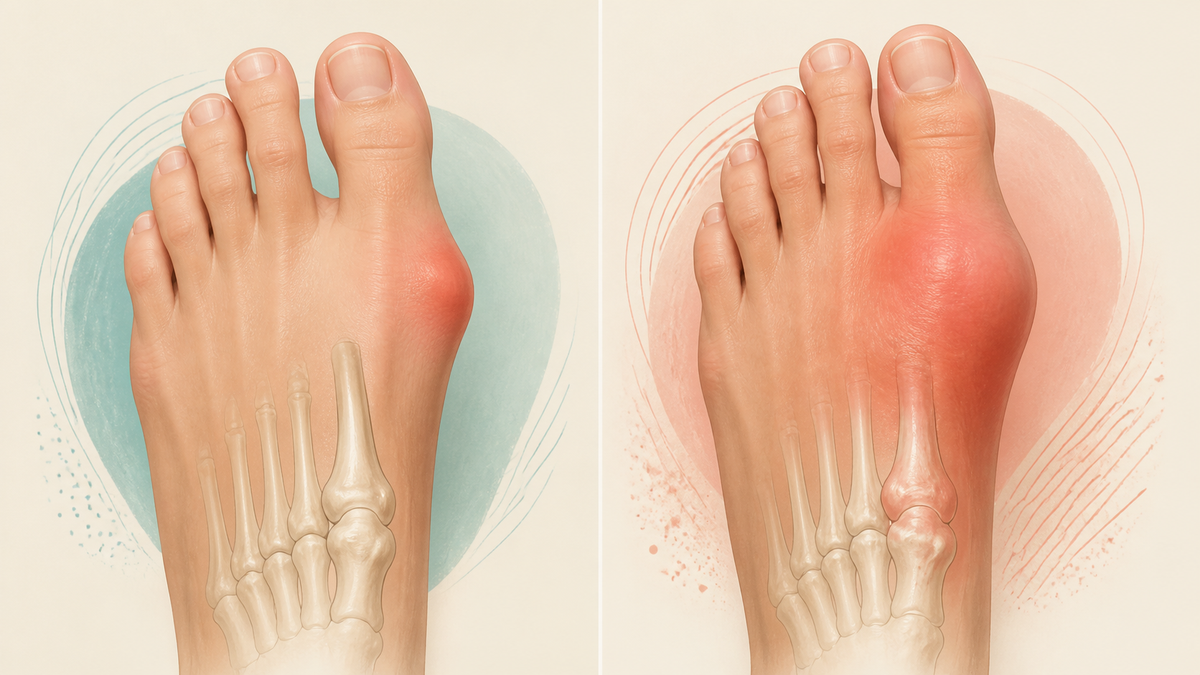
A bunion is a gradual structural alignment change that creates a prominence at the base of the big toe. Gout is an inflammatory arthritis that can cause sudden, severe attacks of pain, swelling, warmth and redness, often in the big-toe joint. A bunion can also become red and sore, so symptoms alone cannot always confirm the cause.
How does the timing differ?
Bunions generally develop slowly, with toe drift and shoe-fit problems becoming noticeable over time. A gout attack often begins abruptly and may become intensely painful within hours.
How can appearance differ?
Hallux valgus often produces a persistent side prominence and visible big-toe angle. Gout may cause diffuse swelling and marked warmth around the joint during a flare without the same longstanding alignment pattern. Either condition can coexist with the other.
Can shoes trigger both?
Tight shoes commonly aggravate pressure over a bunion. They do not diagnose or explain gout, although any contact can be intolerable during an acute inflammatory episode.
When should you seek care?
Seek prompt assessment for a first episode of sudden severe joint pain, substantial heat or redness, fever, a wound, spreading redness or inability to bear weight. Do not assume a familiar-looking bump explains a new acute episode.
How are they confirmed?
A clinician combines history and examination with tests when needed. Bunion assessment may use weight-bearing X-rays. Gout evaluation may involve blood tests or analysis of joint fluid, depending on the situation.
See bunion diagnosis and care boundaries.
Typical patterns side by side
| Feature | Bunion / hallux valgus | Acute gout pattern |
|---|---|---|
| Onset | Usually gradual | Often sudden, sometimes overnight |
| Alignment | Persistent big-toe drift and medial prominence | Alignment may be unchanged during a flare |
| Heat and swelling | May follow friction or joint irritation | Can be intense and diffuse around the joint |
| Pain | Often linked to shoes or push-off | May be severe even with light touch |
These are tendencies, not a diagnostic test. A person can have both hallux valgus and gout.
Why a red bunion is diagnostically tricky
The skin over a prominence can become red after rubbing, while gout inflames the joint from within. Infection can also cause redness and warmth, particularly when the skin is broken. Timing, distribution, fever, wounds and prior episodes help guide the next step, but a new severe episode should be assessed.
What clinicians may test
Bunion diagnosis usually relies on examination and sometimes weight-bearing X-rays. Gout cannot always be confirmed by appearance or a single uric-acid result during an attack. Depending on the situation, a clinician may use blood tests, ultrasound or joint-fluid analysis and consider infection in the differential.
What not to do during diagnostic uncertainty
Do not tighten a corrector over an acutely swollen joint or assume shoe stretching will address sudden inflammatory pain. Remove pressure, avoid forcing movement and seek advice appropriate to the severity of symptoms.
Why symptom timing matters
Hallux valgus develops as an alignment change over time, although its skin and joint irritation can flare after shoe pressure or activity. Gout attacks often reach high intensity much faster. A sudden overnight change is therefore different from a familiar prominence that becomes mildly sore after a day in tight shoes—but neither pattern is conclusive on its own.
When redness needs urgent attention
Spreading redness, fever, drainage, a wound, rapidly increasing swelling or feeling systemically unwell raises concern for infection or another urgent problem. People with diabetes, reduced circulation, immune suppression or reduced sensation should use a lower threshold for professional assessment.


