

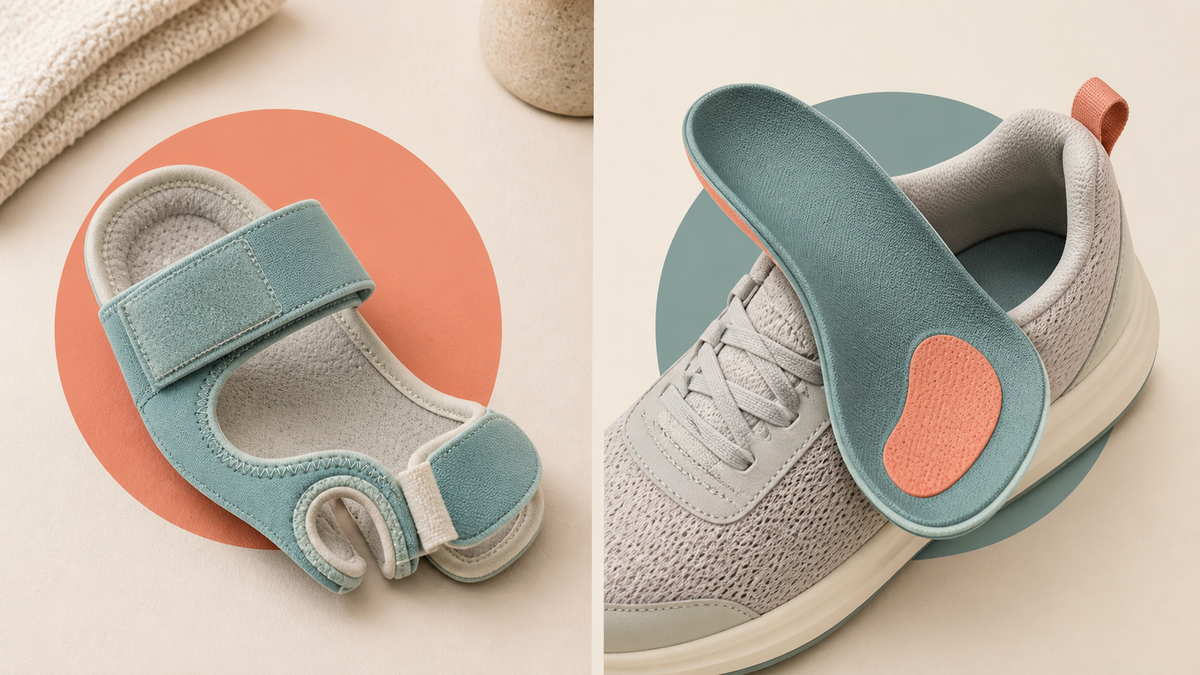
A bunion corrector acts around the big toe and forefoot to support toe position while worn. An orthotic sits under the foot inside a shoe and changes how pressure is distributed or how the foot is supported. They serve different goals, and neither should be expected to permanently remove a bunion. A clinician may recommend an orthosis when broader mechanics or associated conditions matter.
How does a corrector work?
Correctors use straps, padding, a spacer or a frame around the toe and forefoot. Their effects are local and depend on fit, tension and when the design can be worn.
How does an orthotic work?
An orthotic or insole contacts the sole of the foot. Designs range from simple cushioning to prescribed devices intended to modify load or support a particular mechanical need.
Which is better for shoe pressure?
Often the first priority is a shoe with enough room. An orthotic occupies shoe volume, and a corrector may add width around the forefoot, so either can worsen pressure in a tight shoe.
Can they be combined?
Sometimes, but only if the shoe has enough space and each device serves a defined purpose. Introduce one change at a time so you can identify irritation.
What does evidence support?
Research on nonsurgical hallux valgus interventions is limited. Some studies report pain improvement, but permanent structural correction should not be promised.
Read the corrector evidence review.
Product context
Altaeron’s adjustable corrector is designed for local big-toe and bunion-area support. It is not a custom orthotic or a substitute for a gait and footwear assessment.
The devices act from different surfaces
A corrector contacts the big toe and medial/forefoot area. An orthosis works from beneath the foot inside a shoe. This distinction matters: a corrector may influence toe position while it is worn, while an orthosis is more likely to target plantar pressure, support or a broader mechanical goal.
Decision table
| Question | Corrector | Orthotic |
|---|---|---|
| Where is it worn? | Around the toe/forefoot | Under the foot in a shoe |
| Typical goal | Local positional support or cushioning | Redistribute load or support a prescribed mechanical need |
| Needs shoe space? | Yes if worn in shoes; some rigid designs are rest-only | Yes, because it raises or fills shoe volume |
| Custom assessment? | Often sold over the counter | Ranges from retail insole to clinician-prescribed device |
| Proven permanent structural result? | No | No |
When an orthotic conversation makes sense
A clinician may consider an orthosis when symptoms involve plantar pressure, associated flatfoot, arthritis or gait mechanics—not merely because a bunion is visible. A custom device is not automatically necessary, and an orthosis that makes the shoe tight can worsen medial pressure.
When a corrector is the more direct category
Someone seeking local support around the toe while resting may find a corrector more directly aligned with that goal. Fit, skin tolerance and realistic expectations remain essential. Neither device replaces a diagnosis when pain is persistent or the joint is acutely inflamed.
Can both be used?
Potentially, when each has a distinct purpose and the shoe has adequate volume. Introduce one at a time. If the combination crowds the forefoot, changes circulation or creates numbness, remove it rather than treating discomfort as an adjustment period.


