

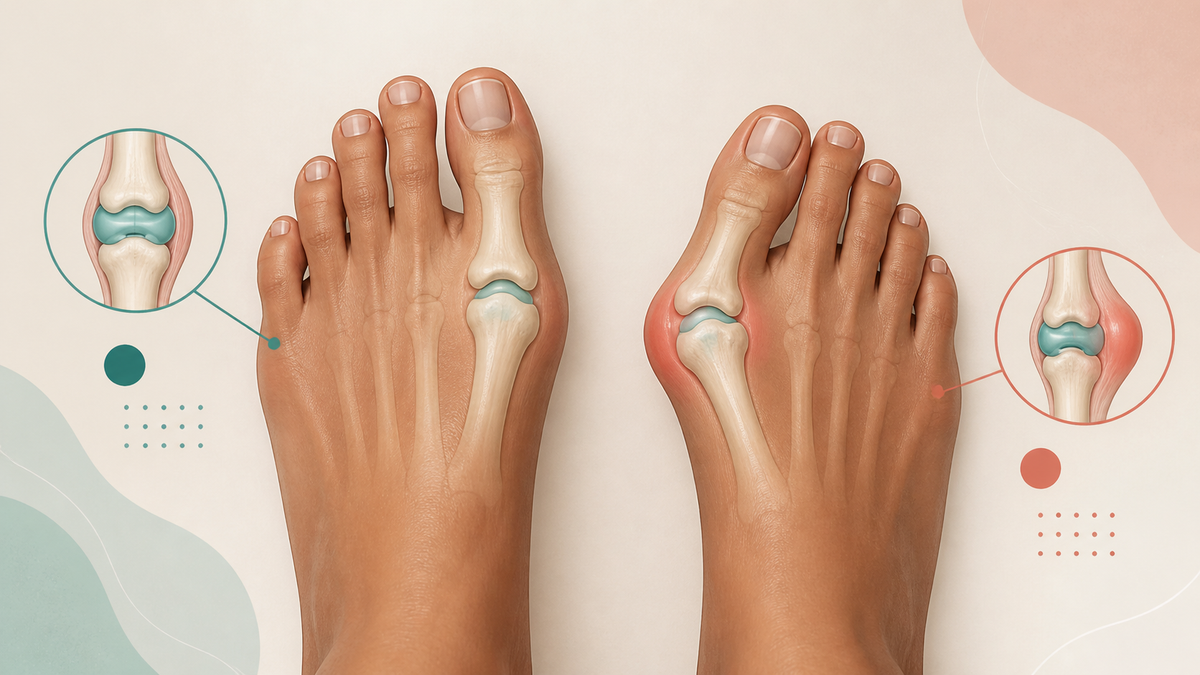
A bunion is a change in alignment at the base of the big toe. The big toe angles toward the smaller toes while the first metatarsal shifts inward, creating a prominence at the first metatarsophalangeal joint. Some bunions are painless; others cause shoe pressure, inflammation, stiffness or difficulty walking. Management depends on symptoms, function and clinical findings—not the appearance of the bump alone.
What is a bunion?
Hallux valgus is the medical name for the alignment change commonly called a bunion. It develops at the first metatarsophalangeal, or MTP, joint. The visible bump is part of a wider change in the positions of the bones and soft tissues, not simply extra bone growing on an otherwise normally aligned foot.
Our guide to bunion terminology and hallux valgus explains the anatomy in plain language.
What symptoms can a bunion cause?
Possible symptoms include tenderness over the prominence, redness after shoe wear, stiffness in the big-toe joint, calluses where toes rub, pain under the forefoot and difficulty finding shoes that fit. Size and pain do not always match: a visible bunion can be painless, while a smaller deformity may be irritated by footwear.
Sudden severe redness, heat and swelling are not automatically caused by a bunion. Read how gout and bunions differ, and seek assessment when the diagnosis is uncertain.
Why do bunions develop?
Bunions usually reflect several influences rather than one simple cause. Inherited foot structure, joint mechanics, certain inflammatory conditions and footwear that crowds the forefoot can all matter. Narrow shoes may aggravate symptoms and may contribute to development, but they do not explain every case.
See what causes bunions and whether bunions can be prevented.
How are bunions assessed?
A clinician usually begins with symptoms, footwear history and a physical examination. Weight-bearing X-rays may be used when the diagnosis, severity or surgical planning requires a clearer view of bone alignment. A photograph or home “stage” chart cannot replace an individualized assessment.
Learn more about bunion diagnosis and how severity is described.
What can help with everyday comfort?
Roomy shoes, a sufficiently wide toe box, soft uppers and reduced pressure over the prominence are common first steps. Pads, toe spacers, orthoses or splints may help selected people manage pressure or symptoms. Evidence for nonsurgical devices is limited, and they should not be presented as permanently reversing the deformity.
Compare the broader bunion treatment options, shoe features and ways to reduce pressure and friction.
Where do correctors fit?
A corrector or splint may hold the toe in a different position while worn and may improve comfort for some users. It does not have the same purpose or structural effect as surgery. For a balanced evidence review, see what bunion correctors can and cannot do.
Altaeron offers adjustable bunion support for readers who have decided that this category fits their comfort goals. Product instructions and stop-use signs still matter.
When should you seek professional care?
Arrange an assessment for persistent or worsening pain, reduced mobility, difficulty walking, numbness, skin breakdown, marked redness or warmth, or uncertainty about the cause. People with diabetes, reduced circulation or reduced sensation should obtain individualized foot-care advice before self-treating a new problem.
Use the detailed guide on when to see a doctor about a bunion.
How does a bunion affect walking and the rest of the forefoot?
The first MTP joint bends as the body moves over the foot. When alignment and motion at that joint change, pressure can shift toward the lesser metatarsal heads or neighboring toes. That helps explain why one person notices only a medial bump while another also develops ball-of-foot discomfort, calluses or crowding of the second toe. These associated problems are not proof that a bunion is “severe,” but they are useful details during an assessment.
Pain should be interpreted in context. Skin irritation from a shoe seam calls for a different response than deep joint pain during push-off or an acutely hot, swollen joint. Start by identifying the location, timing and trigger rather than treating every symptom as pressure from the bump.
A practical way to choose the next step
- Clarify the problem. Is the main issue appearance, rubbing, joint pain, stiffness, toe crowding or reduced walking?
- Remove avoidable pressure. Check shoe width, depth, seams and heel height before adding a device.
- Try one conservative change at a time. This makes benefits and irritation easier to identify.
- Reassess function. A useful measure should make walking or shoe wear easier without causing new pressure.
- Escalate when needed. Persistent limitation, uncertain diagnosis or warning signs deserve professional assessment.
What conservative care can and cannot change
Conservative care can make a meaningful difference even when it does not alter bone structure. A better-fitting shoe can remove a daily friction source. Padding can protect skin. An orthosis may redistribute load for a selected mechanical problem. A spacer or splint may change toe position while worn. Those are legitimate goals, but they are different from surgically realigning the bones.
A systematic review of 18 nonsurgical-intervention studies found low certainty overall. Pain improvement appeared more consistent than improvement in the hallux valgus angle, and study sizes and methods varied. That is why Altaeron uses “may help” language instead of promising correction.
Common misconceptions
- “The biggest bunion must hurt the most.” Appearance and symptoms do not always track together.
- “A pad pushes the bone back.” Padding primarily changes contact and cushioning.
- “Any red big-toe joint is a bunion flare.” Gout, infection and injury can create different, sometimes urgent patterns.
- “Surgery just shaves off the bump.” Modern procedures generally address alignment; the operation chosen depends on clinical and imaging findings.
Questions worth taking to an appointment
Ask what is generating the pain, whether arthritis or another diagnosis is present, which nonsurgical goal is realistic, and what would make imaging useful. If surgery is discussed, ask which part of the deformity the procedure addresses, what recovery involves and what risks or recurrence considerations apply to you.
How the main options compare in everyday life
Footwear and padding can be used during normal activity but only help when they reduce rather than add pressure. Spacers and soft supports may fit in some shoes; rigid splints are usually more practical at rest. Orthoses occupy space beneath the foot and need compatible footwear. Exercise requires repeated participation and has a developing evidence base. Surgery involves recovery and risk but is the category that can change structural alignment.
The “least invasive” option is not automatically the best or safest one. A thick pad in a tight shoe can be counterproductive, and an aggressively tightened splint can create symptoms. Match the method to a defined problem and reassess the result.
How to read bunion claims online
Ask whether the claim concerns pain, function, toe position while a device is worn, an X-ray angle after a study period or permanent structural correction. These outcomes are not interchangeable. Check whether evidence comes from a randomized trial, how many people were studied, how long follow-up lasted and whether the exact retail product was tested. Testimonials and temporary before-and-after positioning do not establish a cure.
Key takeaways
A bunion is an alignment deformity, not just a surface bump. Symptoms and functional limits matter more than appearance alone. Conservative care is mainly used to accommodate the foot and manage symptoms; surgery is the option that can structurally realign bones, but it is generally considered for significant symptoms after appropriate evaluation.


