

Sore, tired feet can make even an ordinary day feel longer than it should.
Maybe your heels feel uncomfortable when you take your first steps in the morning. Perhaps your feet ache after standing all day, your toes feel cramped inside your shoes, or you simply notice that walking isn't as comfortable as it used to be.
The good news is that mild, everyday foot discomfort can often be managed with simple changes to your routine.
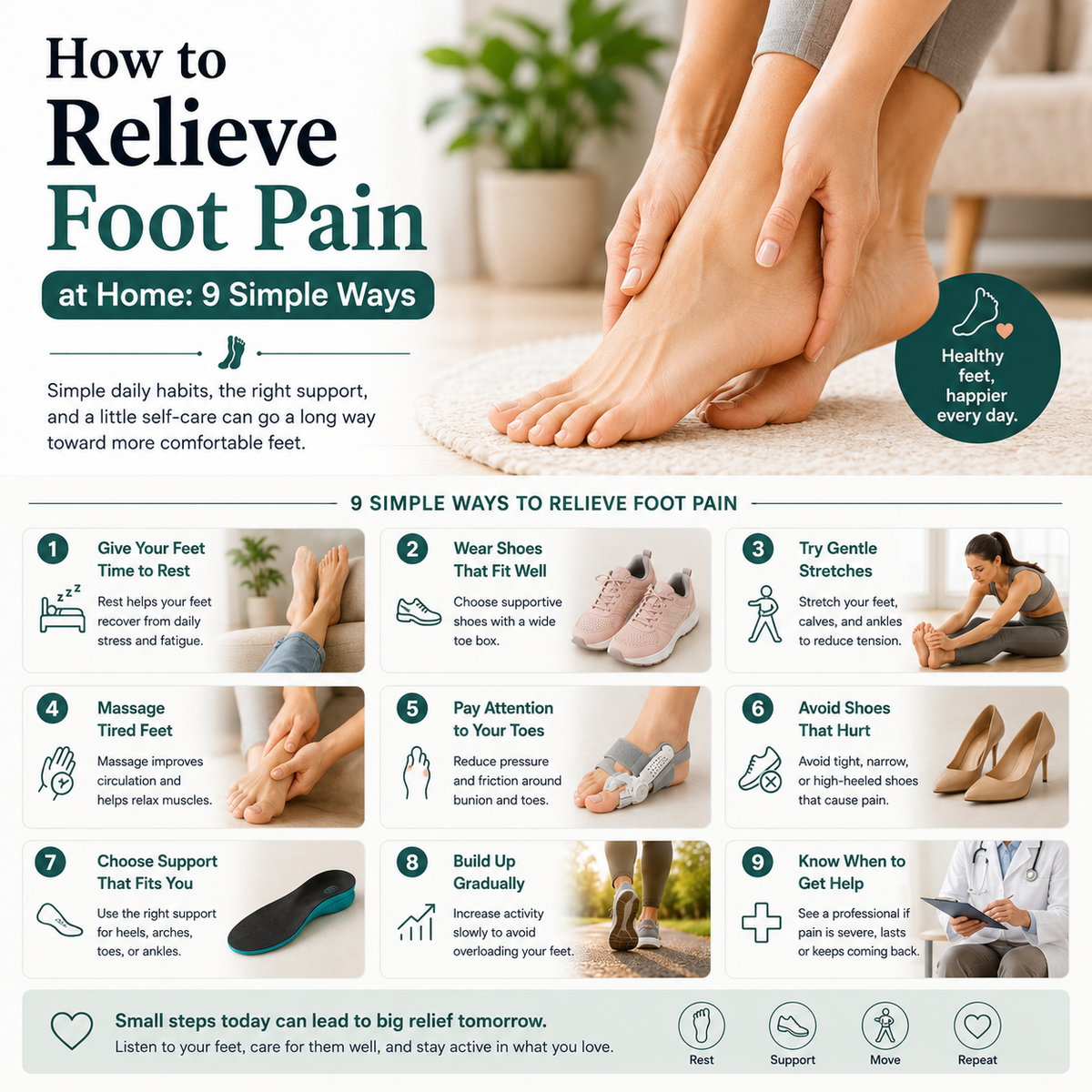
From giving your feet time to recover to choosing better-fitting shoes, here are nine practical ways to support more comfortable feet at home—plus signs that it may be time to speak with a healthcare professional.
Why Do Your Feet Hurt?
Your feet absorb force every time you stand, walk, run, or climb stairs.
Over the course of a day, that's a lot of work.
Foot discomfort can have many possible causes, including:
- Spending long hours standing or walking
- Shoes that are too tight or poorly fitted
- Sudden increases in physical activity
- Pressure around the toes
- Tired or overworked muscles
- Heel or arch irritation
- Bunions and other changes in foot structure
- Limited support from footwear
- Minor strains or overuse
Where you feel discomfort can provide useful clues.
Pain around the heel, for example, is different from pressure around a bunion or discomfort around the ankle.
That's why the first step isn't necessarily finding a product.
It's understanding where your discomfort is coming from and what seems to make it better or worse.
1. Give Your Feet Time to Rest
Sometimes the simplest solution is also the easiest to overlook.
If you've spent several hours walking, standing at work, shopping, exercising, or simply being on your feet, they may need time to recover.
Try reducing unnecessary activity for a while and see whether your discomfort improves.
When you get home, change out of restrictive footwear and give your feet room to relax.
You don't necessarily need to stop moving altogether.
The goal is simply to avoid repeatedly stressing an area that's already uncomfortable.
If a particular activity consistently causes discomfort, pay attention to that pattern.
Your feet are giving you useful information.
2. Wear Shoes That Give Your Feet Enough Room
Shoes can make a surprisingly large difference in how your feet feel.
One of the first things to check is the toe box—the front portion of the shoe where your toes sit.
Your toes shouldn't be tightly compressed together.
This is particularly important if you have:
- A bunion
- Sensitive toes
- Areas that rub against your shoes
- A wider forefoot
- Toe alignment concerns
Look for shoes that allow your toes to rest naturally without excessive pressure from the sides.
The right shoe doesn't necessarily need to look orthopedic.
It simply needs to fit your foot properly.
Check your shoes at the end of the day
Feet can feel slightly different after you've spent hours standing or walking.
A shoe that feels fine for five minutes in the morning may feel completely different after an entire day.
When evaluating footwear, think about all-day comfort, not just how it feels when you first put it on.
3. Try Gentle Foot and Calf Stretches
Your feet don't work independently from the rest of your lower body.
Muscles and tissues around your calves, ankles, and feet all contribute to movement.
Gentle stretching may help some people feel less stiff, particularly after periods of inactivity.
A few simple movements to consider include:
Calf Stretch
Stand facing a wall.
Place one foot behind you while keeping the heel on the floor.
Gently lean forward until you feel a comfortable stretch through your calf.
Don't bounce or force the movement.
Gentle Toe Stretch
While seated, gently move your toes through a comfortable range of motion.
Avoid forcing a painful joint.
Ankle Circles
While sitting, lift one foot slightly and slowly rotate your ankle in controlled circles.
Reverse direction after several repetitions.
The goal isn't to push through pain.
Stretching should feel gentle and controlled.
If a particular movement causes pain, stop.
4. Massage Tired Feet
After a long day, a gentle foot massage can simply feel good.
You can use your hands to massage the sole of your foot, heel, or surrounding muscles using comfortable pressure.
Some people also like rolling the bottom of the foot over a massage ball.
For larger areas such as the calf, a massage device may be another option.
Whatever method you choose, avoid aggressive pressure directly over an injured, swollen, or highly sensitive area.
The goal is relaxation—not seeing how much pressure you can tolerate.
5. Pay Attention to Your Toes
Toe comfort is often overlooked.
If your toes are repeatedly squeezed together inside narrow shoes, pressure and friction can build throughout the day.
This can be particularly noticeable for people with bunions or toes that naturally sit close together.
Start by giving your toes enough space.
Depending on your needs, you may also consider supportive products such as:
- Toe spacers
- Soft bunion pads
- Protective sleeves
- Adjustable bunion supports
These products serve different purposes.
For example, a toe spacer primarily separates neighboring toes while it's being worn.
A structured bunion corrector may provide additional support around the big toe and surrounding foot.
Neither should be expected to permanently change the underlying bone structure.
Think of them as comfort and support tools, not cures.
6. Avoid Shoes That Consistently Make Your Feet Hurt
You don't necessarily have to throw away every pair of shoes that isn't perfectly supportive.
But you should pay attention when the same pair repeatedly causes problems.
Ask yourself:
Do my toes feel compressed?
Does the heel rub?
Does one part of my foot feel sore every time I wear these?
Am I uncomfortable after one hour but fine in other shoes?
Patterns like these can tell you a lot.
High heels and shoes with narrow toe boxes, for example, can place additional pressure toward the front of the foot.
If you're already experiencing discomfort, alternating them with roomier footwear may give your feet some relief.
7. Choose Support Based on Where You Feel Discomfort
There isn't one universal “foot support” that makes sense for every problem.
Different areas of the foot may benefit from different approaches.
Bunion & Toe Discomfort
If pressure is concentrated around the big toe or bunion area, start with roomy footwear and reducing friction.
Depending on your needs, a toe spacer or adjustable bunion support may also provide additional support while worn.
Heel & Plantar Area
If discomfort is concentrated around your heel or the bottom of the foot, consider your footwear, activity levels, and whether gentle calf and foot stretching feels helpful.
Persistent heel pain deserves proper evaluation rather than simply trying product after product.
Ankle
For mild feelings of instability or fatigue around the ankle, appropriate footwear and support may help in some situations.
Pain after an injury, significant swelling, or difficulty bearing weight should be evaluated rather than self-treated.
Tired Feet and Legs
If your feet simply feel tired after a long day, rest, gentle massage, comfortable footwear, and reducing unnecessary pressure may be enough to make your evening more comfortable.
The important principle is:
Match the support to the problem—not the other way around.
8. Build Up Activity Gradually
Have you ever started walking more, returned to exercise after a break, or suddenly spent an entire weekend on your feet—and then wondered why your feet were sore?
Your body needs time to adapt to changes in activity.
Instead of jumping from relatively little activity to long periods of walking or standing, increase your workload gradually when possible.
This gives your feet and lower legs more time to adapt.
The same principle applies when returning to activity after a period of rest.
You don't have to prove anything to your feet on day one.
Consistency usually makes more sense than suddenly doing too much.
9. Know When Home Care Isn't Enough
Not every type of foot pain should be managed at home.
Sometimes discomfort is your body's way of telling you that something needs professional attention.
Consider speaking with a qualified healthcare professional if:
- Pain is severe
- Pain persists or continues to worsen
- You can't comfortably bear weight on the foot
- There's significant swelling
- The foot looks unusually red or feels hot
- You experience numbness or unusual sensations
- Pain began after a significant injury
- A joint appears substantially different than usual
- Foot discomfort is interfering with normal daily activities
- You aren't sure what's causing the problem
Trying more and more products isn't a substitute for understanding what's actually wrong.
When symptoms are persistent or concerning, getting the right diagnosis matters.
What About Ice or Heat?
Both are commonly used for temporary comfort, but they serve different purposes and aren't appropriate for every situation.
Some people find a cool pack soothing after activity, while others prefer warmth when their feet simply feel stiff or tired.
Avoid placing extreme heat or ice directly against your skin.
If you have reduced sensation, circulation concerns, or another medical condition that could affect safe temperature use, ask a healthcare professional what's appropriate for you.
What About Foot Support Products?
Foot support products can be useful when they're chosen for a specific purpose.
The mistake is expecting one device to solve every type of foot discomfort.
For example:
Bunion correctors
Designed to provide support around the big toe and may help with positioning or pressure while worn.
Toe spacers
Separate neighboring toes and may reduce direct toe-to-toe contact while worn.
Ankle supports
Provide varying levels of support around the ankle depending on their design.
Massage tools
Designed primarily for massage and relaxation rather than structural support.
Insoles or arch supports
May change how pressure feels inside a shoe, depending on their design and your individual foot.
Before buying anything, ask:
What specific problem am I trying to solve?
That's a much better starting point than asking:
What's the best foot product?
A Simple Evening Routine for Tired Feet
You don't need an elaborate 12-step routine.
For ordinary tired feet, something simple may be enough:
Step 1: Change into roomy footwear or go barefoot somewhere safe and comfortable.
Step 2: Give your feet a few minutes to rest.
Step 3: Try gentle ankle and calf movement if it feels comfortable.
Step 4: Massage tired areas using light-to-moderate pressure.
Step 5: If you use a support product, make sure it fits comfortably and follow its instructions.
Most importantly, pay attention to how your feet respond.
A routine should leave them feeling more comfortable, not more irritated.
How Can You Prevent Foot Discomfort From Coming Back?
You can't prevent every ache or foot problem, but a few everyday habits can help reduce unnecessary stress.
Wear shoes that actually fit
Don't buy based only on the number printed on the box.
Different brands and styles fit differently.
Rotate footwear
Wearing exactly the same shoes every day isn't always necessary.
Having appropriate options for different activities can be useful.
Increase activity gradually
Give your body time to adapt when changing your walking or exercise routine.
Don't ignore recurring discomfort
If the same area hurts repeatedly, investigate why instead of simply getting used to it.
Choose targeted support when needed
Use products because they address a specific need—not because they promise to solve every foot problem.
Frequently Asked Questions
Why do my feet hurt after standing all day?
Long periods of standing can place repeated load on the feet and lower legs.
Footwear, the surface you're standing on, your activity level, and individual foot mechanics can all influence how comfortable you feel by the end of the day.
Resting, changing into comfortable footwear, and gentle movement may help with ordinary fatigue.
Persistent or significant pain should be evaluated.
Why do my feet hurt when I wake up?
There are several possible explanations for morning foot discomfort.
Because different conditions can cause similar symptoms, persistent morning pain shouldn't automatically be assumed to have one specific cause.
Pay attention to exactly where you feel the discomfort and consider professional evaluation if it continues.
Is walking good for sore feet?
It depends on why your feet are sore.
Gentle movement may feel fine for ordinary stiffness or fatigue, while continuing to walk on an injury can make things worse.
If walking significantly increases your pain, don't force yourself through it.
Can massage help tired feet?
Gentle massage may provide temporary relaxation and comfort for tired feet.
Avoid aggressive massage over injured, swollen, or highly painful areas.
Can a bunion corrector relieve foot pain?
A bunion corrector is designed specifically to support the big-toe/bunion area.
It may help some people with pressure, friction, or comfort while worn, but it isn't intended as a treatment for every type of foot pain and shouldn't be expected to permanently correct a bunion.
What shoes are best for foot comfort?
There's no single shoe that's perfect for everyone.
Generally, look for footwear that fits your foot properly, gives your toes adequate room, feels stable, and is appropriate for the activity you're doing.
The Bottom Line
Foot discomfort doesn't always require a complicated solution.
Start with the basics:
Give your feet room.
Wear shoes that fit properly.
Allow time for recovery.
Use gentle movement and massage when appropriate.
Choose support based on where you actually feel discomfort.
And perhaps most importantly, listen to patterns.
If one pair of shoes always makes your toes hurt, that's useful information. If your heel bothers you every morning, pay attention to it. If pain continues despite changing your routine, don't simply keep buying different products hoping one will solve the problem.
The goal isn't to think about your feet more.
It's to find the right combination of habits and support so you can think about them less—and get back to moving through your day more comfortably.


