

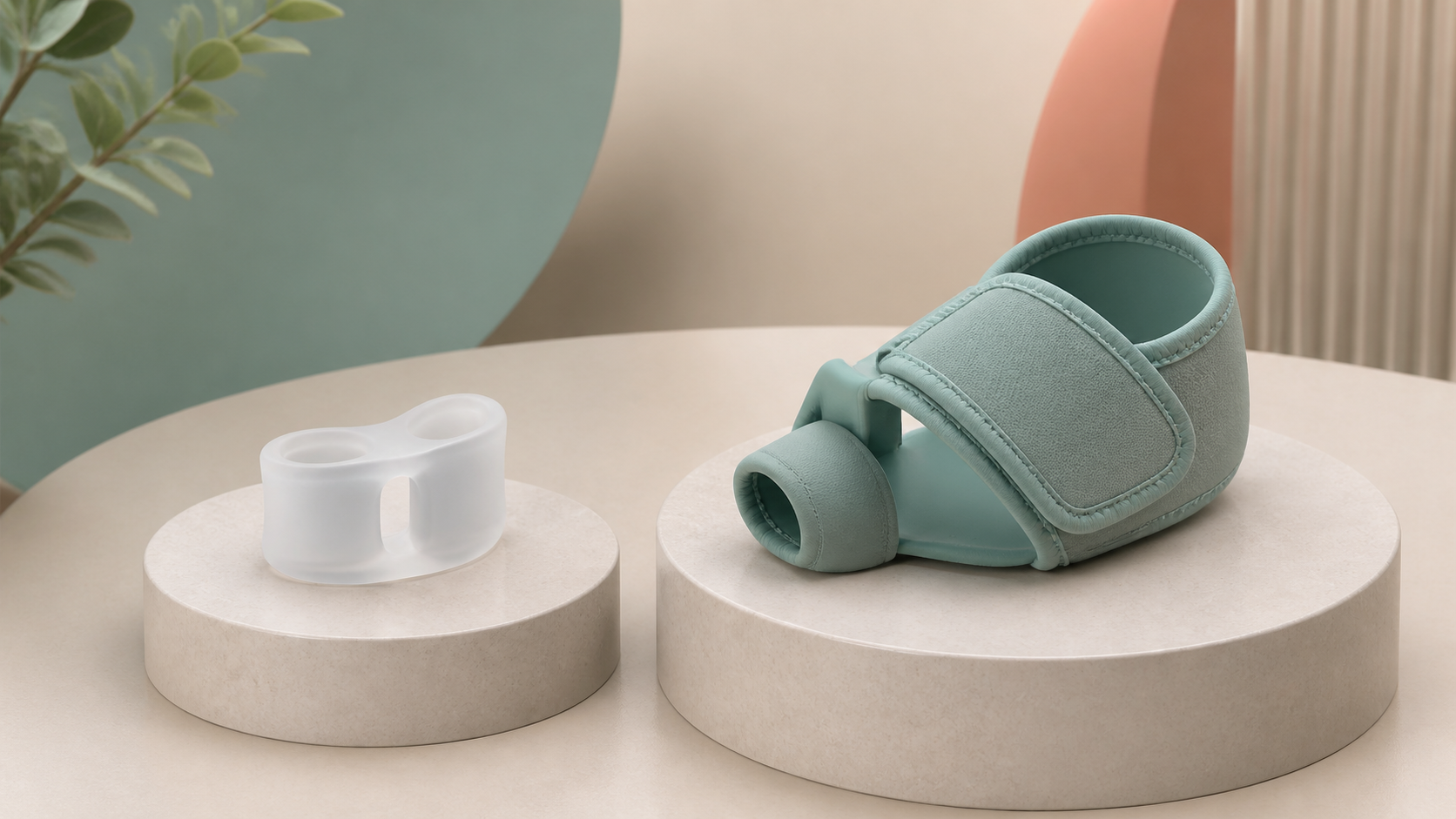
A toe spacer sits between toes to reduce direct contact or hold them apart while worn. A bunion corrector usually combines a toe-positioning element with straps or a frame around the forefoot. Neither category has been shown to permanently cure a bunion. The better choice depends on whether your main issue is toe-to-toe rubbing, broader support, shoe compatibility or comfort at rest.
Comparison at a glance
| Feature | Toe spacer | Bunion corrector |
|---|---|---|
| Primary action | Separates neighboring toes | Supports toe position and anchors around the foot |
| Typical size | Small | More coverage |
| Inside shoes | Sometimes, if space allows | Depends on design; rigid models may not fit |
| Main limitation | Does not address every pressure source | Can create strap or frame pressure |
When might a spacer fit the goal?
A spacer may suit direct rubbing between the first and second toes when there is enough shoe room. Adding it to a narrow shoe can increase pressure.
When might a corrector fit the goal?
A corrector may suit someone seeking adjustable support around the big toe while resting. Check the instructions for the exact design: some are made only for rest, while others permit limited walking, and rigid frames often do not belong inside closed shoes.
Can they be worn together?
Do not combine devices automatically. Layering can crowd the foot, alter tension and create new pressure. Use only a combination explicitly supported by the instructions or recommended by a clinician.
How should you decide?
Define the symptom, the setting and the available space. Stop any device that causes pain, numbness or persistent skin change.
See safe corrector use and pressure-management basics.
Product context
Altaeron’s adjustable bunion support is a corrector rather than a simple standalone spacer. It should be evaluated on fit and comfort, not as a promise of permanent correction.
“Bunion corrector” describes a category, not one design
Correctors may be soft sleeves with a spacer element, strap-based supports, hinged splints, rigid frames or hybrids. Coverage, rigidity, adjustability and intended use vary. A product name alone cannot tell you whether it belongs in a shoe, can be used while walking or is side-specific. The instructions and actual geometry are the source of truth.
Detailed comparison
| Decision factor | Toe spacer | Bunion corrector |
|---|---|---|
| Primary contact | Between the big and second toes | Toe plus straps, sleeve or frame around the forefoot |
| Main goal | Reduce toe-to-toe contact or hold separation while worn | Provide broader positional support while worn |
| Coverage | Usually small | Varies from soft sleeve to rigid splint |
| Adjustability | Usually determined by size/material | May use straps, hinges or a dial |
| Shoe compatibility | Possible only with enough toe-box room | Soft designs may fit; rigid designs often do not |
| Pressure risks | Interdigital pressure or added crowding | Strap, frame, hinge or edge pressure |
| Structural limit | No proven permanent reversal | No proven permanent reversal |
Choose by the actual problem
Toe-to-toe rubbing
A soft spacer may be the simpler option if the skin between the first and second toes is the main concern and the shoe has enough space.
Support while resting
An adjustable corrector or splint may provide broader support, but a rigid frame can create new contact points and may be unsuitable for walking.
Shoe pressure over the bump
Neither device fixes a narrow shoe. Start with footwear; adding material can increase compression.
Marked stiffness or acute pain
Forcing separation or alignment may aggravate the joint. Assessment is more useful than choosing a stronger device.
Construction changes the experience
Soft silicone can be low profile but may trap moisture or move. Fabric sleeves cover more skin and may reduce rubbing, yet add bulk. Straps allow adjustment but can create edge pressure. Hinged or rigid devices control position more directly while worn, but their size usually limits shoe compatibility. These are category tendencies, not guarantees about every model.
Can you combine them?
Combining a spacer and corrector may duplicate the separation element or create excessive crowding. Do so only when the exact corrector is designed for it or a clinician recommends the setup. Add one device at a time and inspect the skin so the cause of any irritation is clear.
What evidence can—and cannot—tell you
The Kwan systematic review examined nine intervention studies and found that orthoses incorporating toe separation appeared important for pain and angular outcomes. The review also identified bias and design variability. A broader nonsurgical-treatment review rated certainty low overall. Neither supports a universal claim that a retail spacer or corrector permanently changes the deformity.
Where the Altaeron products fit
Altaeron’s adjustable corrector is described as a reusable, cushioned support with adjustable tension. The rigid dial-adjustable splint is left/right specific, intended for rest or light indoor activity and not designed for closed shoes. Those facts should guide use; features of other correctors should not be assumed to apply.
When neither device is a good next step
Skip both devices over broken skin, an infected area or an acutely hot and swollen joint. Seek advice when sensation or circulation is reduced, pain is unexplained, the joint is markedly stiff or the second toe is dislocated or ulcerated. A device category comparison cannot substitute for identifying the condition.
Skin sensitivity and material tolerance
Silicone, fabric, hook-and-loop closures and rigid plastic create different moisture and contact patterns. Start with clean, dry skin and short monitored wear. Sweating, dermatitis and prominent joints can make a low-profile soft spacer preferable—or make any enclosed device irritating. Persistent redness, itching, numbness or blistering is a reason to stop.
A decision sequence that avoids guesswork
- Name the main problem: interdigital rubbing, bump pressure, rest-time support or another symptom.
- Make sure the shoe has enough space before adding anything.
- Choose the least complex device that directly addresses the problem.
- Confirm when and where the exact design is intended to be worn.
- Trial it at low intensity and inspect the skin.
- Keep it only if it improves the defined goal without creating a new one.


