

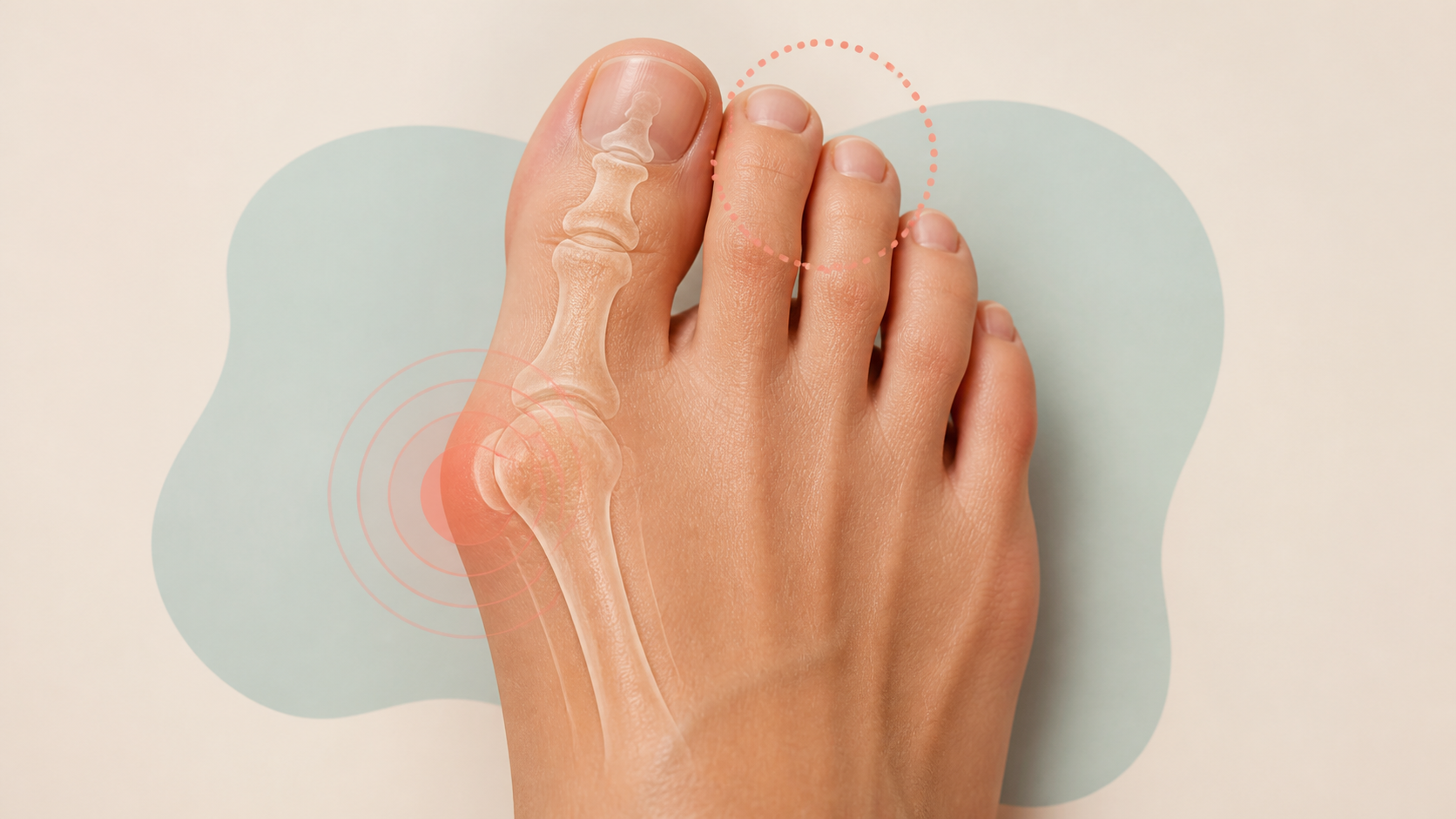
A big toe that gradually leans toward the second toe is a common feature of hallux valgus, the alignment change associated with a bunion. The first metatarsal shifts in the opposite direction, which makes the joint more prominent. Foot structure, mechanics, footwear and medical conditions can contribute, so a visible angle alone does not establish the cause or severity.
What is happening at the joint?
The toe is not simply bending at its middle. Alignment changes at the first MTP joint, and the balance of soft tissues around it changes over time.
See the terminology and anatomy.
Does toe drift always hurt?
No. Some people notice alignment change without pain. Others develop shoe pressure, stiffness, calluses or discomfort under the forefoot.
What else can change toe position?
Prior injury, arthritis, neuromuscular conditions and other foot deformities can affect alignment. Sudden change, acute swelling or inability to move the toe needs assessment.
Can a spacer straighten it permanently?
A spacer or corrector may change position while worn and may reduce contact for some users. It should not be expected to permanently restore bone alignment.
Compare spacers and correctors.
When should it be assessed?
Seek advice for persistent pain, increasing stiffness, second-toe displacement, skin problems, numbness or walking difficulty.
Read when professional assessment is appropriate.
What gradual drift usually suggests
When the big toe gradually angles laterally and a prominence appears at the inside of its base, hallux valgus is a common explanation. The first metatarsal moves medially as the toe angles toward the second toe, changing the shape of the MTP joint and the width of the forefoot.
What to notice besides the angle
- Whether the joint is flexible or stiff
- Whether the second toe is being crowded, lifted or overlapped
- Where calluses form
- Whether pain occurs over the bump, in the joint or under the forefoot
- Whether the change is gradual or followed an injury
Why self-correction can be misleading
The toe may look straighter when pulled by hand or held by a spacer. That demonstrates temporary flexibility or positioning; it does not show that the metatarsal and joint have been permanently realigned. Device decisions should be based on comfort and safe use, not a momentary before-and-after photo.
Other reasons to seek an assessment
A sudden alignment change, new weakness, significant stiffness, acute swelling, numbness or an injury needs evaluation. Arthritis, tendon or nerve problems and other deformities can affect toe position and may require a different plan.
How shoe fit can amplify the problem
A tapered toe box can press the drifting big toe and second toe together while rubbing the prominence on the opposite side. That pressure can create corns, calluses or blisters without being the sole cause of the underlying alignment. A shoe should match the forefoot’s actual width and depth rather than depending on soft material to stretch over a pressure point.
What a useful next step looks like
If the change is gradual and comfortable, start by tracking shoe fit, skin pressure and activity limits. If pain persists, the second toe is becoming displaced or the joint is losing motion, a clinician can assess the entire forefoot and—when useful—obtain standing X-rays. Treatment should respond to symptoms and function, not the angle seen in a single photograph.


